

The autumn equinox is a turning point, the end of summer and the beginning of a new season.
To mark the occasion, UK chancellor Kwasi Kwarteng, in his first major policy announcement, made a big statement last Friday, which sent a strong signal and received and equally strong reaction.
Headline tax cuts
After a lethargic political summer and in the face of a cost-of-living crisis, the so-called ‘mini Budget’ contains measures intended to stimulate the UK economy.
The big news is tax cuts—including reversals of previously announced policies:
- Corporation tax was scheduled to rise next year but will remain at 19 per cent—one of the lowest in the G20. Bankers’ bonuses will no longer be capped (as in the EU) in a bid to “reaffirm the City’s role as a world centre for finance.”
- For UK taxpayers, the basic rate of income tax will be cut from 20 to 19 percent.
- The planned increase in National Insurance contributions is also cancelled.
Changes to stamp duty
The subject of every dinner party conversation—house prices—is back on the menu. The cost of homes has been steady recently, and mortgage rates have been rising in the last months.
However, one crucial lever—stamp duty land tax (SDLT) has now been pulled:
- For buyers, the level at which stamp duty becomes payable was doubled to £250,000 effectively a maximum saving of £2,500 on a house purchase.
- It’s even better for first-time buyers for whom the price threshold is raised to £425,000 from the current £300,000. The limit on the value of a purchase on which the first-time buyer advantage applies jumps from £500,000 to £625,000—a 25-percent bump that’s well above the current rate of inflation
On paper, this is positive, and it is hard to argue with this part of the government’s proclaimed ‘vision to unlock homeownership for a new generation.’
Property portal Rightmove estimates that raising the threshold to £250,000 means that a third of all homes currently for sale are now completely exempt from stamp duty in England (up from 7%). Furthermore, today’s changes mean 66 percent of homes are now exempt from stamp duty for first-time buyers.
But England is a land of contrasts, and each city and region has its own profile. As Tom Bill of Knight Frank put it: ‘The stamp duty cut is welcome, especially by first-time buyers, but it is no reason to get carried away about the prospects for the housing market itself.’
For example, these changes are not likely to have a significant impact on all locations and sectors of the property market. Prime Central London is always competitive. It’s a place where first-time buyers struggle to get a foothold and usually attracts international investors. For the latter, who are looking at the higher end of the market, the impact of changes to SDLT will not be as significant.
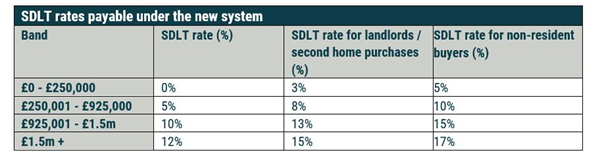
Legal firm Boodle Hatfield quickly published this handy chart as a reminder for non-resident buyers:
SOURCE: Boodle Hatfield
Market response translates to opportunity for investors
The market—in the UK and beyond—responded immediately to the Government’s announcments, sending the value of the pound to a 50-year low. (For better or worse, the UK is still an important part of the global economy and London is a global city).
The trend in the last few years for central London has been lower prices in dollar terms. The Financial Times reports that price falls and the weakening pound mean prices for dollar buyers are 43 percent lower than in 2014, according the Savills.
Those holding dollar-denominated capital could find themselves at an advantage in terms of exchange rate. Yes, values in parts of prime central London are considered evergreen, and real prices are by no means low. Nevertheless, the fleet-footed might be able to act now as we move into Q4 to realise any currency advantage.
So, depending on your perspective and your position, this could be a ray of sunshine before winter comes.
For someone looking for a UK home and for long-term investors, the autumn leaves are lovely; the glass is half-full.
To subscribe to updates from Longview, fill in the form below:


